

The Proceeds of Crime.
Updated: Mar 3
Surely not? Multi-billion-pound 'highly regulated' utilities with highly paid CEOs, making money by systematically breaking the law?

You might quite reasonably be thinking, no , you must be wrong! '
Ok, this is why we are not.
Illegal pollution is highly profitable and regulation keeps it so.
Here is the short version.

Explainer.
Privatised water companies in England and Wales obtain, treat, and distribute drinking water and collect and treat sewage before releasing it to the environment as required by law, primarily under the Water Industry Act 1991. They are funded entirely by customer bills.
For illegal pollution, let's look at just one aspect, the well-known illegal dumping of untreated sewage.

This is a prolific and profitable activity and what happens in reality is very far from the short-term 'spills' that water companies claimed were only made to stop sewage backing up into homes. They can, and do, go on for weeks or even months.
It has been proven, principally as a result of the work of WASP's Prof Peter Hammond, that sewage is dumped far more frequently than was claimed by the industry and the Environment Agency.
He has also shown where these events are illegal, either because they are 'early spills' when untreated sewage is released before the required amount is sent for treament, or 'dry spills', when there has not been enough rainfall to excuse the dumping.
In 2024 over 3.6 million hours of sewage dumping took place in England, and in Wales, it was almost a million.
Bear in mind that in many cases the rainfall threshold that counts as an excuse for the Environment Agency is 0.25mm - yes, a quarter of a millimeter.
That is the thickness of two £50 notes, by the way -because this is all about money.
Remember also that the Office for Environmental Protection investigated this issue and found that the government, the Environment Agency, and Ofwat, had all failed to apply the law correctly, and failed to recognise that sewage can only be dumped legally in exceptional circumstances.
How widespread is the illegal spilling? In short, very, and you only have to look for sewage outfalls with very large numbers and long durations of spills to spot the likely suspects.
Or look a couple of days after the rain stopped to see those that are still discharging - and that is by the weaker and unlawful standard that the OEP criticised, so it is actually much worse.
Links for investigation, if you want to take a look yourself, are at the end of the blog.
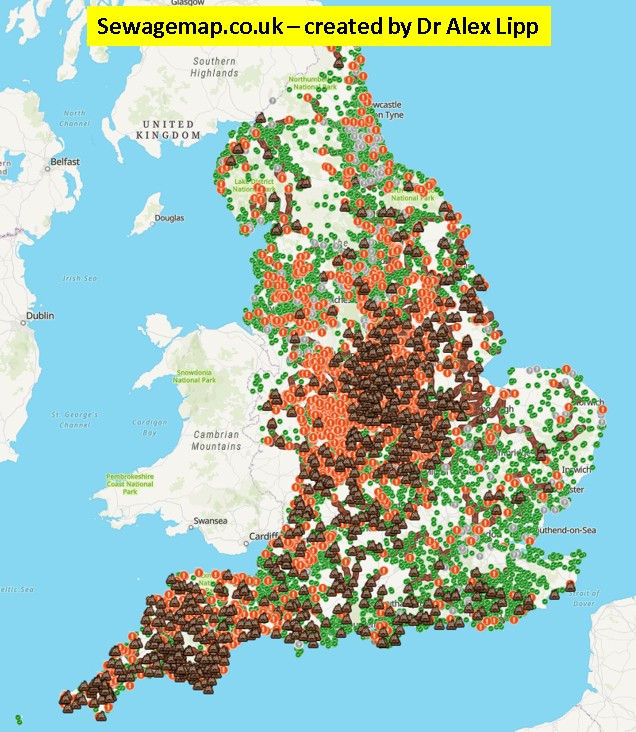
Thus, it is very easy to identify sewage works and outfalls that frequently operate illegally. The solution to that is spending money on fixing the problem, often under capacity sewage works or systems, and also leaky networks, allowing groundwater to overload the system.
None of this sneaked up on anyone - fixing it was meant to be the reason for privatisation. The water industry has been funded by billpayers to do this maintenance and upgrade work over the 35 years of private ownership and the water company Boards of Directors have certified to Ofwat that they have had the funding to do it, year on year.
To put the next bit simply, they just haven't, and instead, the industry adopted a strategy of 'sweating the assets'. This was based on extracting as much cash as possible from the annual billpayer harvest and not fixing anything until it was utterly unavoidable. The government policy for prosecution (hardly ever) and deregulation by the back, front, and every other door meant that illegal pollution that was a consequence of the asset sweating paid off - massively, and became part of the business model. Crime paid so it was kept in.
The suggestion that any of this this is the responsibility of junior staff and middle managers is ridiculous, as has been commented on by at least two Crown Court Judges, Judge Sheridan about Thames Water in 2017 (£20M fine) and Justice Johnson in the 2021 Southern Water case (£90M fine). But the staff, forced into impossible situations, have been the only people to take the blame. The bosses even picked up big bonuses while doing it.
After the big fine cases, the suggestion that bosses did not know or make the decisions that prolonged illegal operations became even less credible. As we know, water CEOs are paid extortionate fees for the 'exceptional skills and abilities' they bring, and those include the assessment and management of corporate risk in which they all must have judged illegal pollution to be a profitable activity. And they were right.
Any water companies are welcome to come back with evidence that this is not the case - but actual evidence like board minutes, accounts and actions, not claims.
So, what have the Boards done? Carried on polluting illegally and, in some cases, even diverted money from agreed upgrades and thereby continued illegal operations - a commercial choice from which they made money.
Next point - fixing sewage works and networks seems to be ridiculously expensive as revealed in the WASP blog such as charging £16M for a 3 tank upgrade at Witney and asking £435M for a mere upgrade of Oxford sewage works - operating since 2017. https://www.windrushwasp.org/single-post/it-pays-to-cheat
Take themoney from fixing all the illeglly operating assets away from profit, and you will be largely left with nothing from which to extract dividends and bonuses, and as that is the case; the available money can only be the result of continuing criminal activity and thereby the proceeds of crime.
Excuses from the offenders?
'Ofwat would not let us spend money to upgrade.'
But according to two Ofwat CEO's, since 2014, water companies have been free to spend money to upgrade assets and infrastructure where they are not delivering for communities and the environment.
Thames Water managed to find £1Million to pay consultants to help avoid being taken into public ownership, so it shows the company can be flexible when it wants to, just not when it comes to doing the right thing.. https://www.inkl.com/news/thames-water-paid-1m-plus-to-corporate-spooks-firm-part-owned-by-starmer-adviser
In general terms, to demonstrate the principle, it matters not at all that the companies were not prosecuted for the offences; they made the money by breaking the law.
However, if we are talking about applying the Proceeds of Crime Act 2002, it does matter, because a prosecution and conviction is a requirement to invoke recovery of the proceeds. https://www.legislation.gov.uk/ukpga/2002/29/section/6
Various committees and government ministers have been told by the Environment Agency how hard it is to prosecute water bosses, and we agree, it is very hard if you don't look for the evidence.
But if you do a competent job, this is what can and should happen.
These are cases involving waste companies dealing with things like the plastic disposal that famously showed up in Oxfordshire near the River Cherwell in January.

Now look at the water industry and consider that Thames Water has over 180 criminal convictions for similar offences, including those where thousands of fish died or public health was put at serious risk, and all you will find are fines, paid for by the billpayer and a revolving door between regulators and water companies.
When WASP's Vaughan Lewis asked in 2022:
"How many times in the past 10 years has the Environment Agency used the Proceeds of Crime Act to reclaim funds from offenders following prosecution?"
The answer was:
"Since September 2012 we have successfully obtained PoCA Confiscation Orders in respect of 72 separate cases. 98 orders were obtained in total as some of these cases involved multiple individuals/companies."
12 of the 98 were for waste companies and zero for water companies. That was 4 years ago, but the zero is still a zero.
Final thought.
The government is trying to pretend that Channel 4's Dirty Business didn't happen, and we need your help to make sure it can't forget because things are not getting better, they are getting worse.
We haven't even mentioned the health risks brought so tragically home in Dirty Business because this blog is focused on the proceeds of crime. The consequences of crime are coming another day; they are all around us and they all lay at the door of the profiteers and those that enable them.
Perhaps you might email or write to your MP and ask them what they are doing to end the water company scandal and pollution for profit.
Remember,it doesn't have to be like this.
Links for the curious
You can use WASP's Prof Hammond's illegality map for Thames Water https://www.peter-hammond.com/TWMAP.html
or Dr Alex Lipp's https://www.sewagemap.co.uk/ for all of the companies in England and Top of the Poops excellent link to constituencies and much more , including Wales https://top-of-the-poops.org/
The Rivers Trust also has a good one https://theriverstrust.org/sewage-map
And so does Surfers Against Sewage https://www.sas.org.uk/sewage-map/ as well as the water companies themselves, which vary in helpfulness - one of the best is our own Thames Water in this respect.
You will soon find those that suit your needs. Good luck.
Finding reliable information about Delta Executor Roblox isn't always easy, but this guide was clear and helpful. It saved me time and made the whole process much simpler.
Really important topic, thank you for shedding light on it. Environmental issues can feel overwhelming, so I appreciate how this article breaks things down. On a lighter note, when I need a mental break from heavy news, I like to use a random animal generator to see which species needs a spotlight, and a warrior cat name generator is fun for naming local wildlife characters. Even organizing volunteer sign-up sheets feels easier with a last name generator. Thanks again for the informative read!
In my work as a Sacramento Bail Bond I love helping people get out! At the end of the day I feel good about what I have done.
While working in a shop that rebuilds car and truck transmissions, I discovered a hidden benefit to InDesign. It makes it easy to generate lines and rounded corners quickly. It makes my work repairing transmissions much easier!
Girl games is so fun