


Prof Peter Hammond on BBC Panorama with Joe Crowley
Peter Hammond is a retired university academic and campaigner for sewage-free rivers. He was Professor of Computational Biology at UCL’s Institute of Child Health until his retirement in 2015, where he used artificial intelligence and image analysis to detect brain and facial shape differences associated with genetic disorders and prenatal alcohol exposure.
From 2015 to 2018, Peter Hammond continued part-time research at the University of Oxford’s Big Data Institute. Since 2016, he has campaigned for sewage-free rivers and seas with WASP (Windrush Against Sewage Pollution), working closely with founder Ash Smith to expose pollution and push for regulatory action.

Did you know... Sewage can be legally discharged into rivers
Excess sewage discharges can be permitted in "exceptional circumstances", such as "unusually heavy rainfall".
But even then, it must be treated to certain standards.
Water companies routinely break the law in this respect but are seldom prosecuted.

The Environment Agency has missed the majority of
illegal discharges.
Our analysis shows that many unpermitted spills go undetected by the Environment Agency.
This is partially because they only request daily data from water companies.
We use data recorded at 15-minute intervals.
Meanwhile, water companies keep the money flowing out as dividends and interest payments on loans they did not need.

Compelling evidence shows how privatisation is the root cause of the industry's failure to deliver for anyone but owners, creditors, and bosses.
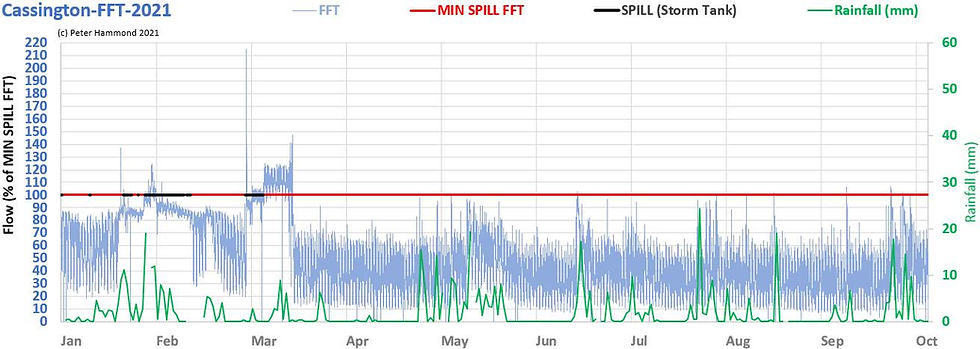
Sewage spills last for months
The brown block shows when untreated sewage was spilled.
It's happening for weeks and months on end.
This is not an exceptional example.

Screenshot sewagemap.co.uk
This has a devastating effect on our waters
Only about 14% of English rivers are in good ecological status.
In the Thames region it may be as low as 6% and we know that in many cases the assessments of the Environment Agency appear unrealistically optimistic.
People may argue over the causes, but unchecked pollution is always going to do damage and it has become the water industry norm.
It's already too late for some of our wildlife
Every spring, wildlife tries to bounce back from a winter of pollution.
But eventually it will be unable to recover.
We may have already lost the rare filter feeders, called Crystal Moss Animals, which once lived in Chil Brook.

A small colony of Bryozoan Lophopus, also known as Crystal Moss Animal
© www.micrographia.com